Compression testing
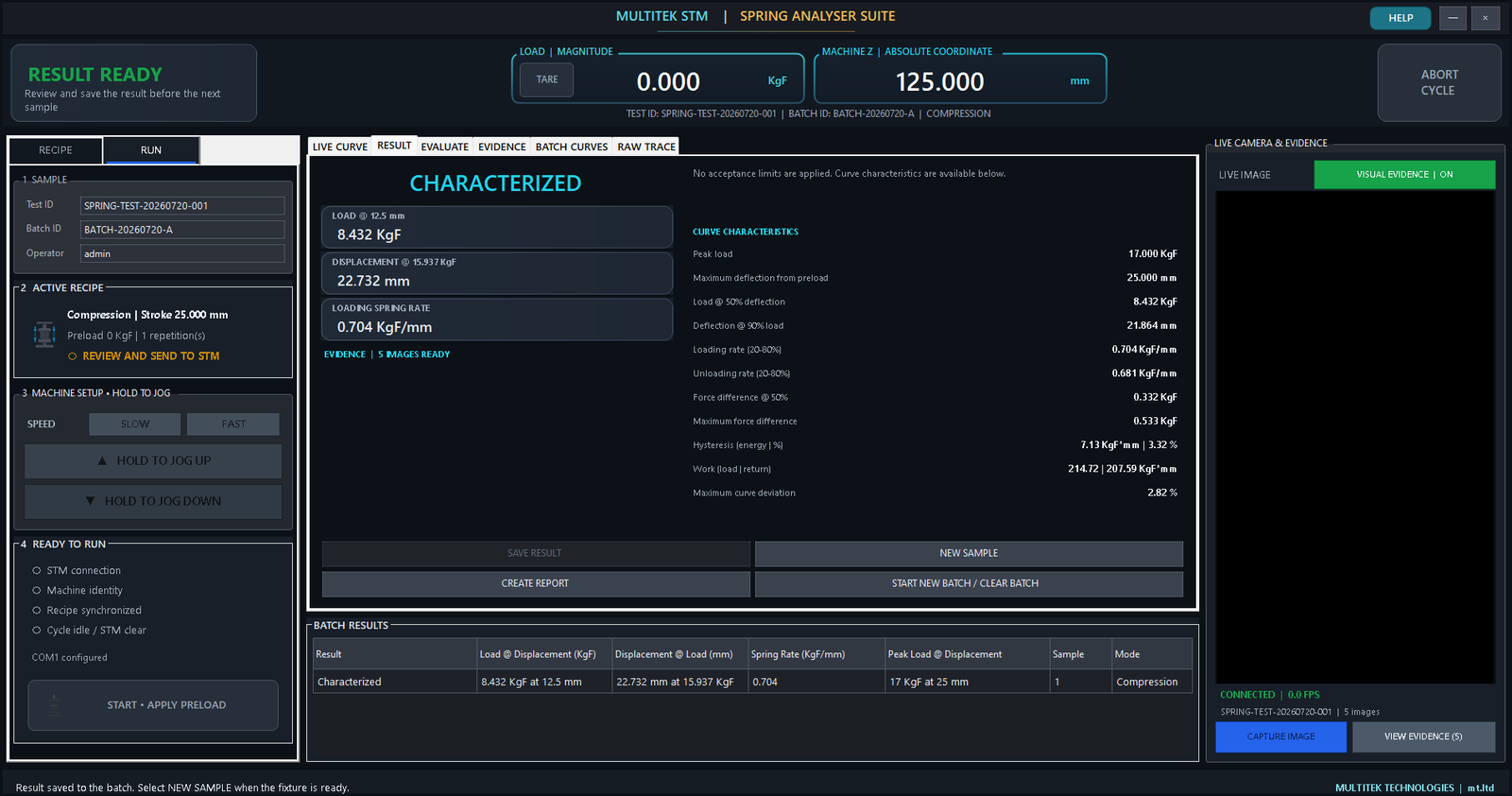
Apply preload, establish the test datum and measure a controlled compression stroke with live loading and return curves.
Testing procedure →STM-X turns force and movement into defensible spring-test evidence—from confirmed preload datum to characterized curve, batch result and report.
Every accepted force-position reading stays paired through the live display, curve, raw trace, calculation, recovery and report.
Apply preload, establish the test datum and measure a controlled compression stroke with live loading and return curves.
Testing procedure →Characterize force, travel, rate and initial-tension behaviour with fixtures suited to spring ends and hooks.
Extension guide →Calculate load at displacement, displacement at load, loading rate, return rate, peak values and hysteresis.
See the software →Create a consistent three-page report with summary, curve characteristics, evidence and calculation provenance.
Reporting workflow →STM-X keeps the absolute Machine Z coordinate unchanged and calculates automatic test displacement from the first eligible confirmed preload datum.
Recipe, run readiness, live curve, result, evaluation, evidence, batch curves, raw trace and reporting are kept together.
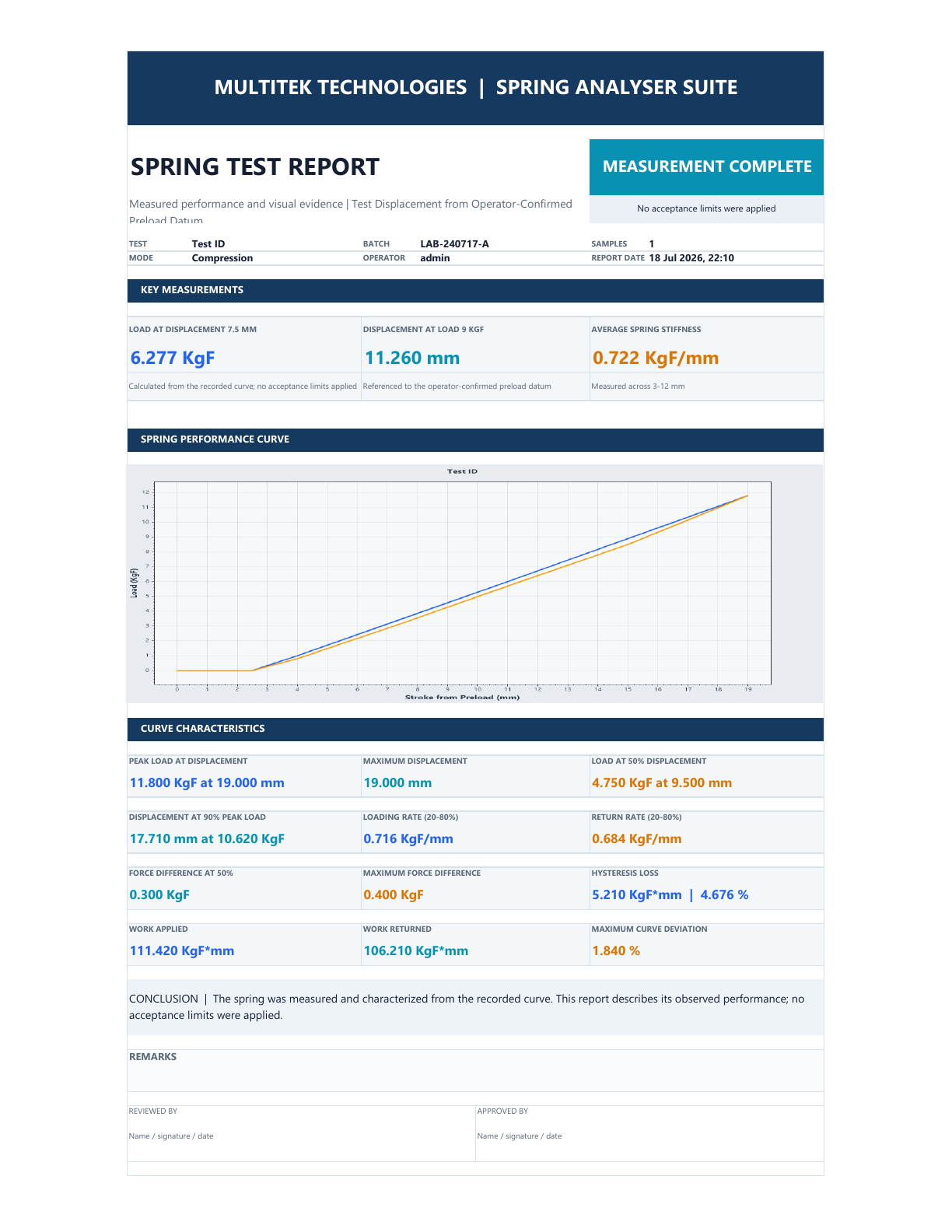
STM-X composes an immutable report model from the completed test. The result does not depend on a live screen staying open.
Executive summaryKey measurements, performance curve and characteristics.
Visual evidenceCorrelated images with load and displacement context.
Calculations & traceabilityFormula locations, units and measurement provenance.
Practical, versioned guidance grounded in measurement discipline—not keyword-stuffed product copy.
A practical introduction to compression and extension spring testing, the measurements a spring tester records, and what a load-deflection curve reveals.
02 Curve interpretationLearn how to interpret seating, the working range, spring rate, peak load, unloading behaviour and anomalies on a spring load-deflection graph.
03 Calculation guideCalculate spring rate from two force-deflection points, understand units, and learn why a defined measurement interval is more reliable than a single-point estimate.